home

elow: All Saints church who's crypt contains the 1st Duke of Leeds, Thomas Osbourne. It was commisioned by Earl William de Warenne, son in law of William the Conqueror circa 1080 AD. Earl Warenne was granted vast land holdings for his part in the Norman invasion, including Harthill manor. His wealth was equivalent to, or in excess of Bill Gates' (Warenne was valued at £10,000 in 1080, or £54 billion in 2000!). The first pic below is of the west facing side. The church celebrated its 900th birthday in about 1979. This church was valued at £1.25 million for insurance purposes in 1999, compared to £689 in 1831. Culturally it is irreplaceable, a link back through 1,000 years of history.

Exterior shot, Hatrthill All Hallows

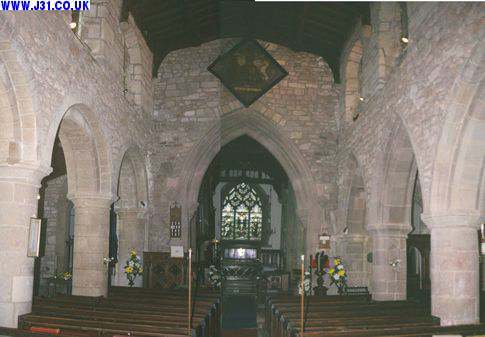
Interior shot, Hatrthill All Hallows

Norman style arches

These are the Norman style arches that constitute the oldest part of the church. Normans (northmen) were essentially Danish Vikings who had conquered what was to become the Normandy area of northern France, and England in 1066. Building started soon after William the Conqueror gained control of the region in about 1070. The area was then under the rule of the Norman knight William de Warenne who founded the church. After about 1200 the style changed to early English .

Headstone of Richard Ashby, Duke of Leed's park keeper

'Mr Richard Ashby, Park Keeper to His Grace the Duke of Leeds; died the 1st Day of March 1778. Aged 67 Years. In the midst of Life We are in Death.'

There are lots of pubs in the area called the Leeds Arms - This is because the area was once run and owned by the Duke of Leeds. In 1673 the manor of Harthill was sold to Sir Thomas Osbourne of Thorpe Salvin, who became Duke of Leeds in 1694 (d1712). Osbourne ancestors had been born in the areal and this church became their family tomb, and many of the Dukes descendents are buried in the family vault inside the church, and at Wales church. There are 30 coffins in the crypt, many of infants, and as a sad modern footnote the crypt was attacked by tomb robbers in 1990. They broke open coffins in search of valuables but got such a meagre haul that the items that they took were found abandoned in the church's porch several days later!

Here lies, buried up against the church walls outside, is one of the Duke's employees. Not the 1st Duke's though, as Richard was only 1 year old when the 1st duke died. See the Kiveton pages for a view of how kiveton hall looked, and the 1760 map for an outline of the estate.

home

Web design, content, gfx by Techasaurus. Page content copyright Paul Newbold 2010.