

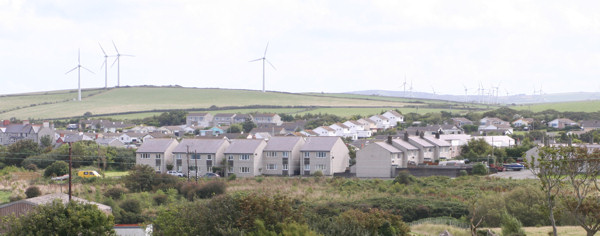
When plans were announced to build three 95 metre/315 ft high wind turbines at Loscar between Thorpe Salvin, Harthill and Whitwell (click here to open a copy of the Rotherham Council's April 2005 planning notice.) there was a flurry of local objections, mostly because the turbines would be visible for miles around and have a significant impact on traffic, noise, and wildlife. The turbines above are in Anglessey, and of a similar height. There's also applications in for turbines near to Ulley in 2009, complete with local action group to fight the proposals!
Such 95m wind turbines could under ideal condition generate around 2000 kw of electricity each. To put that into perspective a three bedroom house might use about 2.5KW, so each wind turbine could, in theory, power about 800 houses (there's about 750 houses in Harthill), or 2400 houses for all three. The snag is that the wind doesn't blow all the time and their actual output could be anything from 20% to 70% of their theoretical output - when planning such sites greenpeace claim that 35% of maximum is assumed (http://www.yes2wind.co.uk/faq.html). And of course because their output is not guaranteed there needs to be other power sources available to generate power on windless days, or too windy days when the rotors have to be shut down to prevent damage. These other power generators presumably sit idle when the wind farms are operating normally. There are also problems storing wind output when it is in excess of demand. Basically, it's difficult to store when demand is low - maybe it could be used to generate hydrogen for burning at peak times.
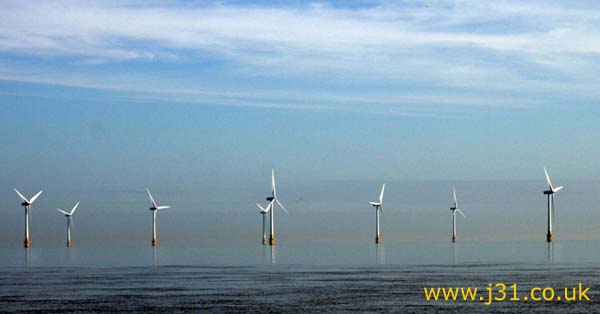
Below are offshore wind turbines in the North Sea off the Norfolk coast at Gt Yarmouth. Off shore generally has a higher output and availability.
Incidentally, the electricity a wind turbine can generate increases by around a factor of over 3 with each doubling of the rotor size. Also, higher towers get them above ground turbulence for better performance. The bigger rotors are also slower, and evidence suggests that they kill fewer birds (although domestic cats kill far more wild birds that wind turbines as there's 10 million moggies in the UK!).
So while huge wind turbines sound like a great and green idea, the case for them isn't clear cut. Personally I find it puzzling that just 3 are planned at Loscar - such a small number will produce minimal power, enough to power a Harthill size village, but at the cost of having standby generation capacity for windless days. But 3 will still have a high environmental impact per kw.
Wave and tidal power seems a better better bet given that we live on an island, and that if there's one thing you can depend on it's that the tides will come in and out twice a day - there are no tideless days, and the North Sea oil and gas industry has given us world class expertise in deep water operations. That's assuming that the UK doesn't throw away its lead in the development of this technology (see The Times 9 Feb 2006). A barrage across the Severn estuary could supply 5% of UK's electricity needs.
One much easier and lower risk/cost way of cutting our dependence on oil and gas is by simply using less than we do now. For example, in the figure above of 2.5kw for a 3 bedroom house, how much is used by old style incandecent light bulbs? If there's, say, seven 60 watt bulbs on at any one time then the house uses 420 watts (or 0.43Kw) for lighting. If they are replaced by low energy bulbs then there's seven x 11 watt or only 77 watts for lighting - an 82% reduction in electricity used for lighting! And of course the house is just as well lit as before so there's no sacrifice in convenience or lifestyle for 'going green'.
The new generation of LED lights can in theory replace that 420w with just 20w (although they are very expensive at 2009).
We now find one barrel of oil for every four we consume. Dr. Colin Campbell, ASPO president, in his testimony to the House of Commons. Also, according to an article in the Sunday Times, the last year in which oil companies discovered more oil than the world was using was about 1980! It's been downhill ever since with predictions that 'Peak Oil' will be reached as early as 2010 (when demand exceeds the supply no matter how much oil we try to pump - do a google search on the subject). See HALF GONE: Oil, Gas, Hot Air and the Global Energy Crisis by Jeremy Leggett. Ironically, given the mass pit closures in the J31 area of the early 1990s, this could trigger a a renaisance in coal mining! See the book SUSTAINABLE FOSSIL FUELS, The Unusual Suspect in the Quest for Clean and Enduring Energy, by Mark Jaccard. Reopening the local pits would be difficult though as they were abandoned rather than mothballed, so their galleries will be flooded with water and methane, and desparately unsafe from roof collapses, etc. Apparantly these are sometimes called sterilised reserves. Also,it is very expensive to sink a new pair of shafts to open a new mine. UK Coal say UKP400-500m for a new colliery.
An alternative way of getting at the coal is underground coal gassification - a technique where the coal is burnt below ground and the energy extracted. The waste stays underground, so no pit tips, and the pit head gear would look more like an oil drilling platform crossed with an electricity power station than a colliery. THe UK has the necessary precision drilling expertiese from the North Sea gas and oil field operations. The technology is proven and in operation elsewhere - see The Times 14th Oct 2007). It just needs the go ahead from the government. Oxygen and steam are forced into the coal seam and ignited, which breaks down the coal to form syngas containing hydrogen (H2) and carbon monoxide (CO) which can burnt on the surface to drive a turbine to release energy, water, and CO2. The big issue is that CO2 and other pollutants need to be scrubbed from exhaust, or it just becomes another polluting energy source. See also the coal mining pages.
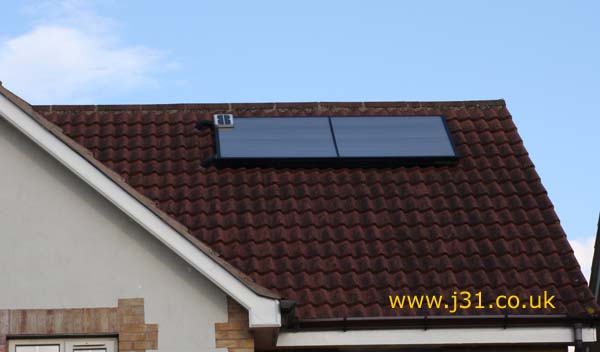
The cheapest way of cutting your energy burn is to insulate and draught proof your house,but after that a relatively cost effective way to cut gas use is to instally a solar hot water panel on your roof (as long as it's roughly south facing). This is a 'off grid' SolarTwin flat panel on a domestic roof. It generates about 1000kwh of energy per annum.
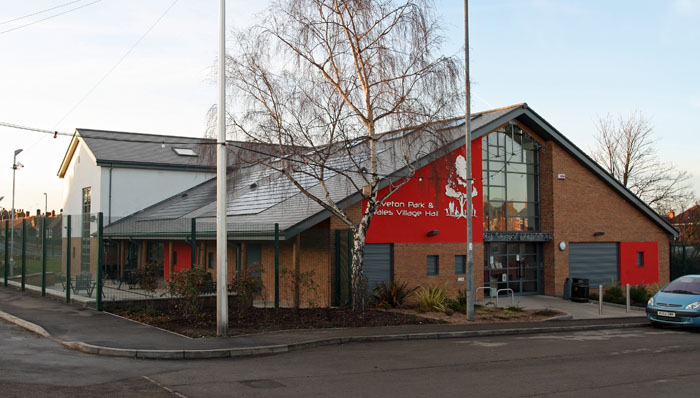
Solar hot water panels should not be confused with solar pv (photovoltaics),as shown below on the roof of Kiveton and Wales Village Hall. They generate electricity and are considerably more expensive than solar HW.
Another Times article Waiting for the lights to go out contains the gem that A barrel of oil contains the equivalent of almost 25,000 hours of human labour. A gallon of petrol contains the energy equivalent of 500 hours - enough to propel a three-ton 4x4 along 10 miles; to push it yourself would take nearly three weeks. So while not all UK 4x4s are v8 4.7 Litre Landcrushers that do 17 mpg, there is a circa 30% fuel consumption penalty for most four wheel drives compared to the same engine in a 'normal' car (due to their weight, large cross sectional area and poor aerodynamics).
For an excellant (and free) detailed look at the options we have for renewables see Cambridge physics Prof David MacKay's 2008 online book Sustainable Energy - Without the Hot Air
Web design, content, gfx by Techasaurus. Page content copyright Paul Newbold 2010.